Emil Shevelev's Gargoyles project, parkour photography in Montreal
Feature

The Ones Who Stay Close

Emil Shevelev on photography, parkour, and finding another way to stay inside the culture.

Words by Chris Ilabaca April 2026

There are people in this community who you watch for years without really noticing them. Not because they're invisible, but because what they do doesn't shout. It sits quietly in the background. Steady. Present. And then one day you stop and actually look at the body of work and think, how did I not see this sooner?

Emil Shevelev is one of those people.

Emil didn't plan any of this. But the best shifts rarely are.

He's based in Montreal. He's been in parkour since 2004. He's made two films with his collective, Mind the Gap and Gargoyles. He's been published in Müv Magazine, photographed SPL events in Vancouver, exhibited work in Prague at the Holding Hands exhibition, and self published a photo book alongside his latest film release. He's done all of this without a plan. Without a brand. Without any of the usual noise. Just a camera, a community, and a quiet discipline that runs through everything he does.

We didn't sit down together for this one. Emil's in Montreal, I'm on the Wirral. I sent over a set of questions and he sent back his answers. That's how a lot of these features come together when the community is spread across the world. But reading through what he wrote, the angle became clear. This isn't a photography story. It's a story about what happens when your relationship to movement changes and you have to figure out how to stay close to the thing that shaped you.

We don't talk about that enough in this sport. The shift. The moment when your body starts telling you something different and you have to decide what comes next. Some people drift. Some people pretend nothing's changed. And some people find another way in.

Emil found his through a viewfinder.
Like most of us, it started with a screen.

I was 19 when I first saw Jump London in 2004. It immediately caught my attention and pushed me to dig deeper, where I discovered videos of David Belle. Seeing the way he moved and realising what was possible made me want to get out and learn to move like that myself.

— Emil Shevelev

The photography came later. A friend called Max, someone Emil met through parkour in Toronto around 2010, gave him a Nikon D40 for his birthday. From there he just started shooting whatever caught his eye. No grand ambition. No business plan. Just curiosity and a camera.

The real shift happened in 2018 on a road trip back from Seattle with his friend Sam, someone he'd known since school, considers a brother, and started parkour with. Sam suggested he focus on photographing parkour. The logic was simple. Emil already understood movement. He already understood timing. He was already surrounded by the people doing it.

It made perfect sense. I was already surrounded by athletes and knew how to anticipate the moment.

— Emil Shevelev

That's the thing about a good suggestion. It doesn't invent something new. It names something that was already there.

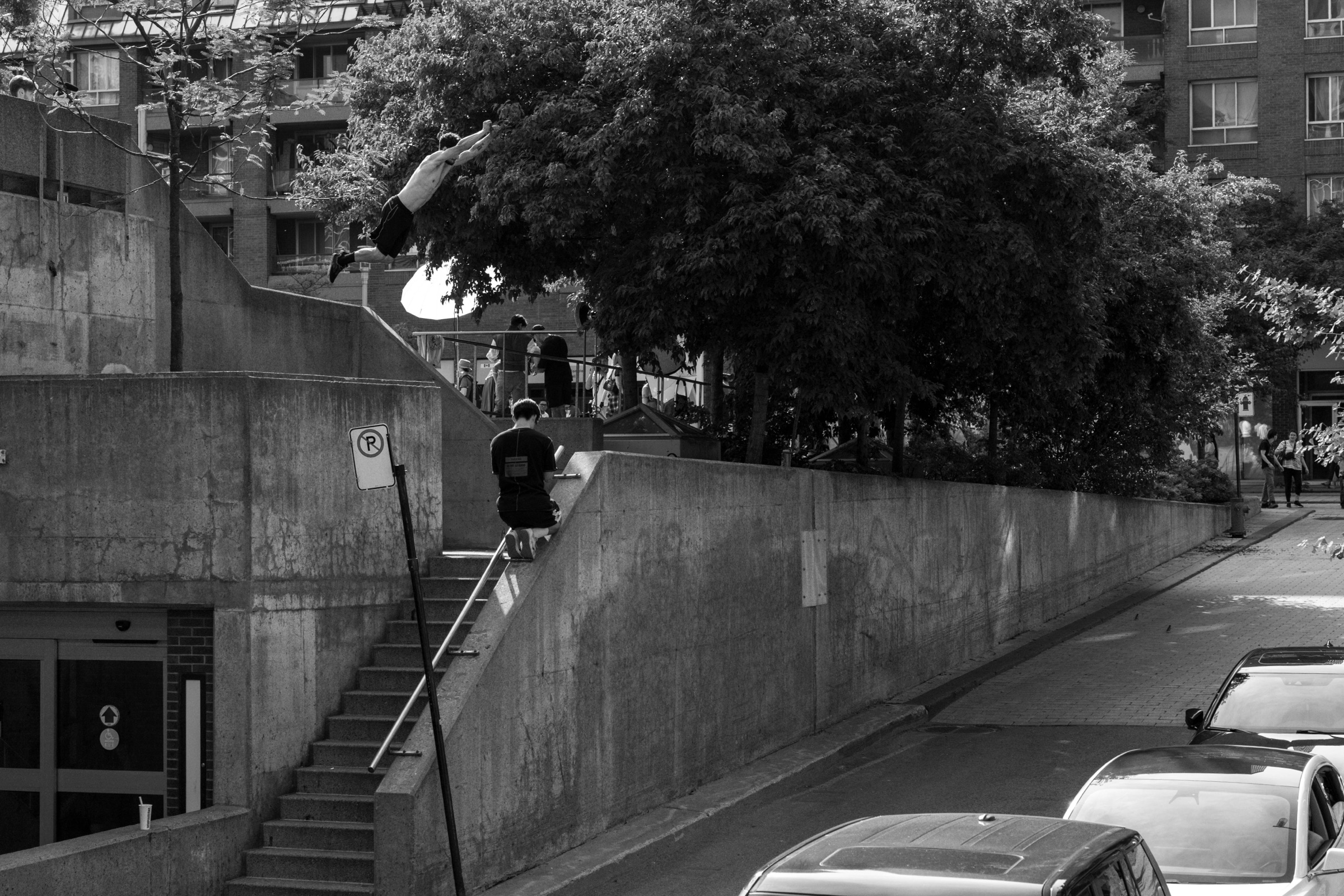
Jeremy Gagnon starting the Gargoyles project with a huge drop in Montreal
Jeremy Gagnon. Gargoyles, 2025. Photo: Emil Shevelev.

There's a moment Emil describes that I keep coming back to.

He'd just finished warming up at a spot under a bridge in New York. A few vaults in and people started getting into some interesting challenges. He had that pull, the one every practitioner knows, where your body wants to get involved. He understood the spacing. He wanted to try it.

Then another thought crept in.

That angle would be so dope on camera.

He chose to grab the camera and shoot.

I'll never know what either choice would have led to, or what I might have missed out on. What matters is making a decision and being at peace with it.

— Emil Shevelev

That peace didn't come easy. A friend once told him something that stuck. Do one thing at a time. Whatever you came to do, commit to it. Simple advice, but it cut deep. Emil realised he'd been splitting his focus. Giving 50% to jumping and 50% to shooting. And 50% only ever produces half of what's possible.

If I wanted to improve, I had to become more disciplined and accept that the fear of missing out was holding me back. Reminding myself that 'it's okay' made it easier to let go of that desire, and the fear that came with it.

— Emil Shevelev

I love that honesty. Because the fear of missing out in parkour is real. You see your friends progressing while you're behind a lens. You see challenges that your body still understands even if it's not the one doing them anymore. Letting go of that, genuinely letting go, takes more discipline than most people realise.

When I asked whether the shift was planned or natural, his answer was perfect.

I didn't plan it. I only became aware of it at one of the jams, on a day I wasn't jumping. It revealed itself to me that I could be surrounded by that energy while experiencing parkour through a lens. Two things I'm truly passionate about.

— Emil Shevelev

He also mentioned, almost in passing, that recovery takes longer now between training sessions. The camera hasn't just given him a creative outlet. It's given him a way to stay connected to movement through another form of expression. That's not a loss. That's evolution.

She showed up, put in the work, and earned her place on her own terms

On Louisa Chang's Olympic Stadium Wall Run

In 2025, Emil and his collective released Gargoyles, their second film. The first, Mind the Gap, had placed third at the Motus Awards and been nominated at the Storror Parkour Awards. For a collective that had zero visibility and just appeared out of nowhere, the recognition hit hard.

It meant a lot to be seen by a group of people whose work I have been a big fan of for such a long time. It was a total honour.

— Emil Shevelev

But with recognition came expectation. They'd set a standard. And now they had to keep it up.

A little stressful when we thought about it. But when we didn't, our work flowed well and we completed another film we are really proud of.

— Emil Shevelev

Gargoyles took nearly two years. Schedule conflicts. Injuries. The usual weight of making something real with people who have lives and jobs and other commitments. But the crew stayed. And this is the part that matters to me, because the way this group works says something important about how things actually get made in parkour.

Dylan Cheung returned as main camera operator and editor. Lucas Begin took on art direction, animation, and additional editing. Max Lee Pottie handled graphic design and served as editing supervisor. Jeremy Gagnon covered sound engineering and music supervision. Everyone wore multiple hats. Nobody had a title. They just did what needed doing because they cared about what they were building together.

Having so many people wearing multiple hats really came through and made the project what it is.

— Emil Shevelev

That's how it works, isn't it? Not with departments and budgets. With people.


Everyone was tasked with finding at least five to seven challenges. They went on bike rides through random neighbourhoods. Most of the spots came from things people noticed on their daily commute to school or work. Only a handful were found through Google Earth. Before the camera crew showed up, athletes had to go inspect each location and confirm the challenge was actually doable.

That process tells you something. Montreal isn't a backdrop for this crew. It's home. The challenges came from the streets they walk every day. That's the kind of connection that gives a project soul.


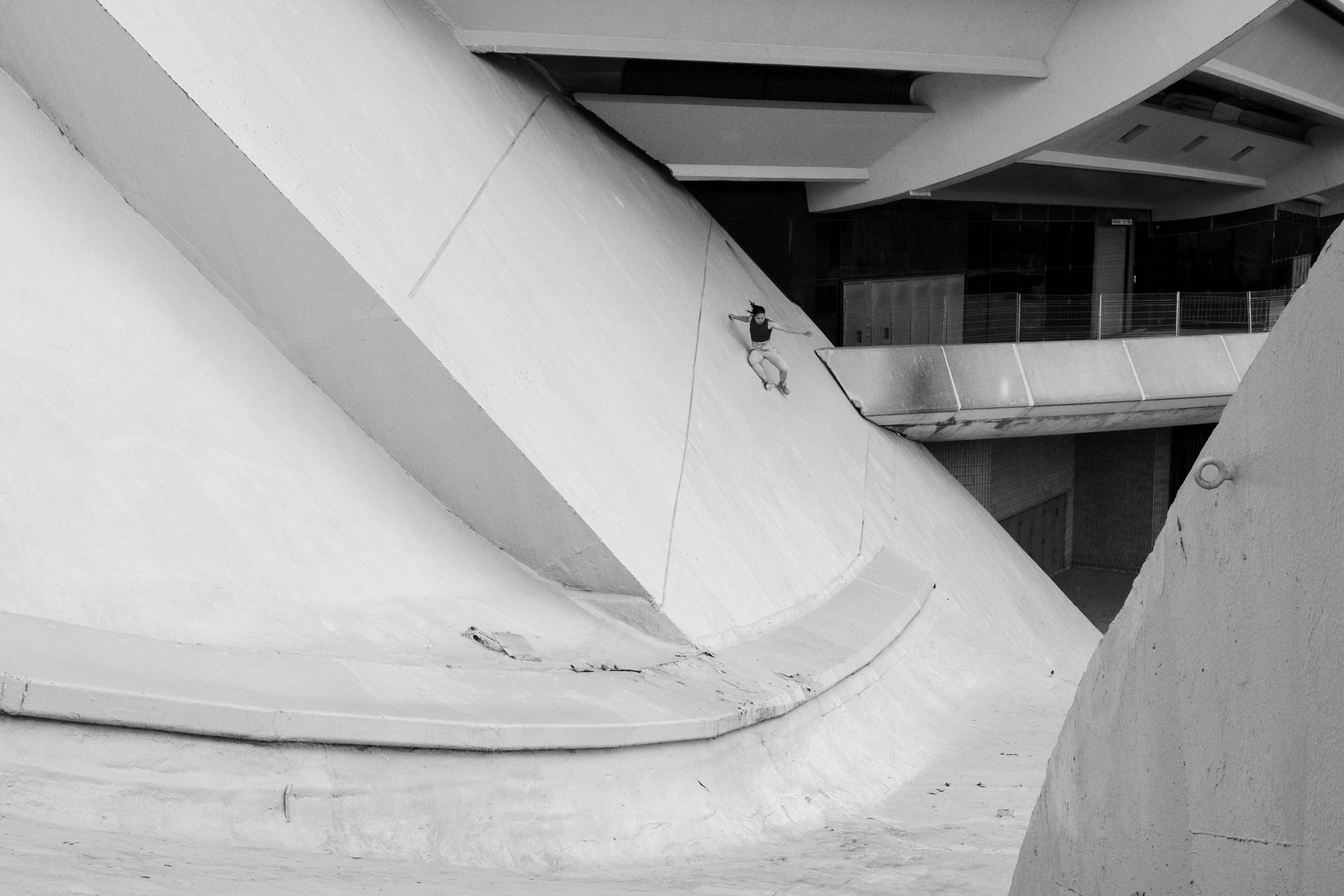
One of the standout moments in Gargoyles belongs to Louisa Chang. First woman to do Montreal's iconic Olympic stadium wall run.

I wanted to know what that was like to capture. What it felt like being behind the camera for something that significant. Emil's answer surprised me.

Following her to the location, it almost felt like she had already done it. There wasn't much stress on my end while filming, and she seemed super calm too. Like it wasn't a huge challenge.

— Emil Shevelev

That calmness. That quiet certainty. It's one of the most powerful things you can witness in this sport. The moment before a big challenge where the athlete has already made the decision and everything else is just physics.

When it's time to film, I lock in completely. I don't really feel much in that moment. I'm more in my head, making sure everything is set up and ready to get the shot. The feelings come after, when we celebrate the accomplishment.

— Emil Shevelev

Let that sit for a second. He locks in. He goes cold. The emotion comes after. That's not just a photographer describing their process. That's an athlete's brain. The same mental framework that parkour trains into you, that ability to switch off everything except the task in front of you, Emil has transferred it behind the lens.

Louisa Chang performing Montreal's iconic Olympic stadium wall run
Louisa Chang. Gargoyles, 2025. Photo: Emil Shevelev.

But there's another side to this. The moments they didn't capture. Tommy Charest committing to a drop after a long mental battle. Paul Brault visualising a roof gap he'd been eyeing for a couple of years. Those internal battles, the preparation, the doubt, the resolve, went largely undocumented.

Part of it was simply not thinking to film those moments, and part of it was not having enough crew to handle additional cameras for BTS or photos. Sometimes everything happens so fast that there's only time to film the challenge and get out.

— Emil Shevelev

He's honest about it. And I respect that. Because the instinct in most people is to only show the wins. Emil shows the gaps too.

Through that experience, we learned two key things. Always have more than one person there to film, and capture more behind the scenes footage.

— Emil Shevelev

The stuff that happens before the jump is often the real story. Anyone who's been there knows that.

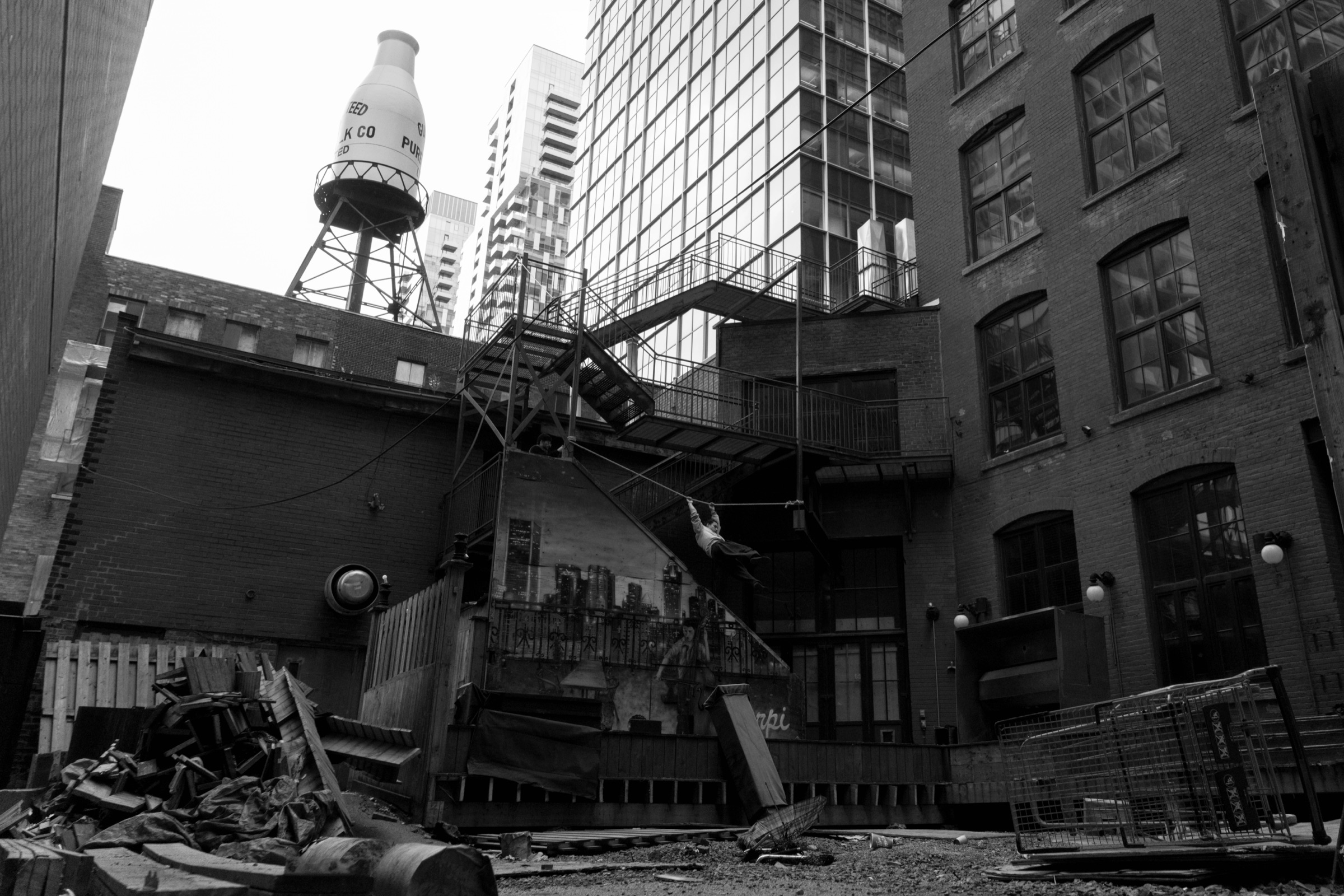
Tommy Charest committing to the drop after a long mental battle
Tommy Charest. Gargoyles, 2025. Photo: Emil Shevelev.

Alongside the film, Emil self published a photo book. When I asked why, his answer was simple.

I enjoy looking at physical photographs. Prints at exhibitions or in photobooks. It allows me to give them more time than I would to any image on my phone. There's something special about holding an image in your hands, seeing the details, and having the space to really take it in.

— Emil Shevelev

I love that. In a world where everything lives on a screen for three seconds before being swiped away, Emil made something physical. Something you can sit with. Something that exists outside of an algorithm.

His shooting approach reflects the same intentionality. He keeps a 24 to 105mm lens on the camera at all times so he's always ready. Before he starts shooting, he walks the location. Watches how people interact with the space. Builds the environment in his mind. Finds angles that feel like strong compositions. Shoots until he's satisfied, then moves on.

When it comes to what makes a strong parkour photograph, you hear the athlete in him.

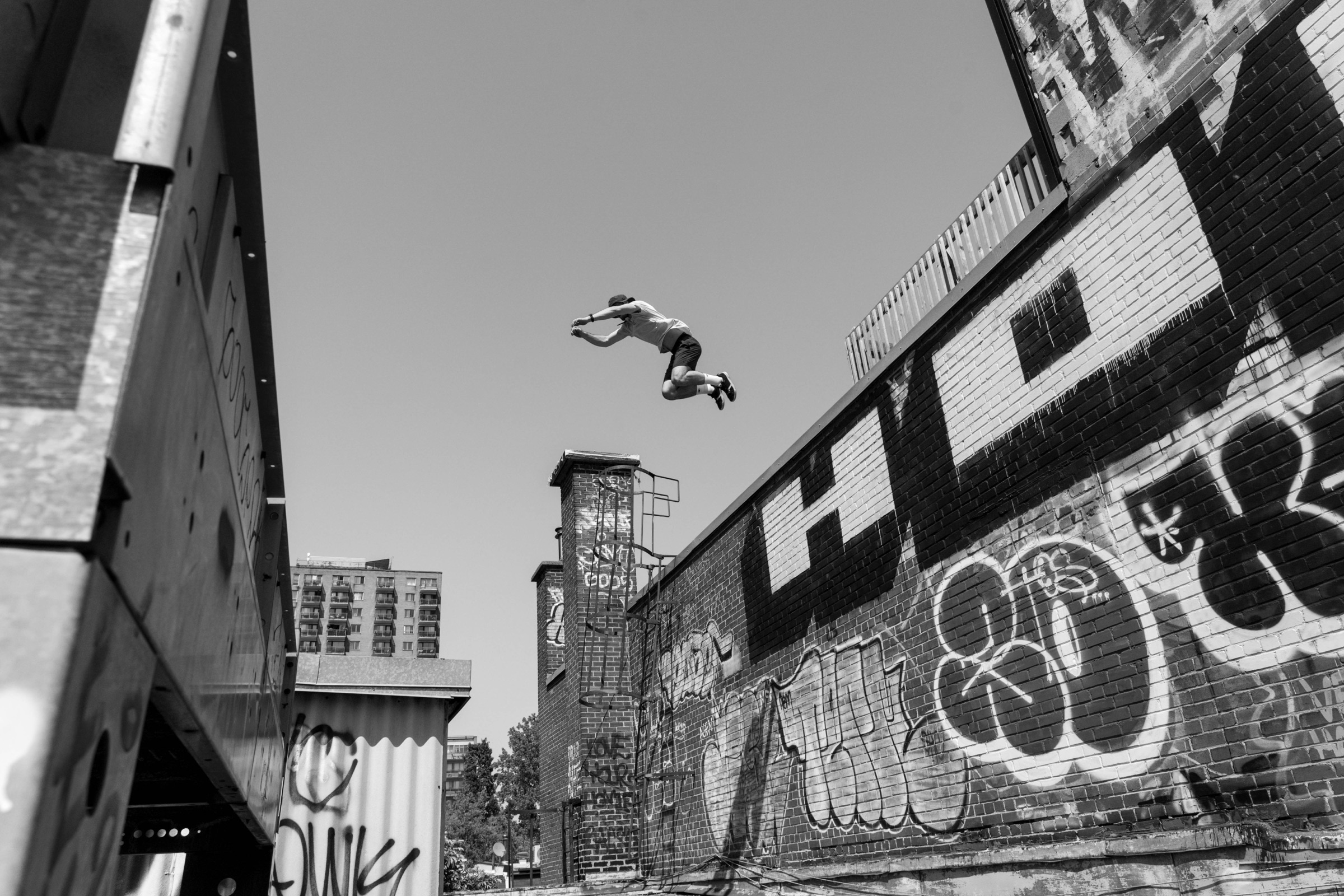
A strong parkour photo captures both the takeoff and the landing to show the scale of the jump. I also like when the subject is as isolated from the background as possible, so you clearly see the athlete's form without a busy backdrop distracting from it.

— Emil Shevelev

He name checked Emily Dyan Ibarra as the first parkour photographer he discovered, someone whose work still sits among his favourites, and Jack Dodds, whose recent wide angle close up work he admires. You can trace those influences in his images if you look for them.


I'm currently working on a collaboration with Avanti Garda x Mind the Gap, a project we started last year when they came to visit us in Montreal. This summer, some of us will be travelling to Europe to finish it.

— Emil Shevelev

He'll be behind the camera again. But he's hoping to get in front of it too.

Fingers crossed.

— Emil Shevelev

I hope he does. Because the thing about someone who's lived on both sides, who understands what it means to jump and what it means to document the jump, is that they carry both with them wherever they go. And that dual perspective is what makes his work resonate.

There's a version of this story where the shift feels like a loss. Where stepping back from movement gets framed as something sad. An athlete who couldn't keep up. A practitioner who had to find a consolation prize.

That's not what this is.

Emil didn't leave parkour. He found another way to be inside it. The camera didn't pull him away from the culture. It pushed him deeper in. And the work he's making, the films, the photographs, the books, they're not about parkour from a distance. They're about parkour from someone who still feels it in his body even when he's not the one jumping.

The collective he's built says something too. About how things get made when nobody's getting paid and nobody's got a title. You just show up because the thing matters. That's how it's always been in this sport. And projects like Gargoyles are proof that the model still works.

I keep thinking about that moment under the bridge in New York. The pull between jumping and shooting. The decision that had to be made. The peace that came after.

That's the thing about the people who stay close.

They always find a way.

☵ 15 / 15 FULL PHOTO CURATION

Still in Motion.

Fifteen frames from Gargoyles, presented as Emil shot them.
With every caption, every name, every context.

VIEW THE FULL PHOTO CURATION →